
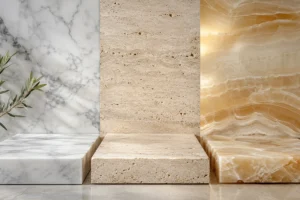
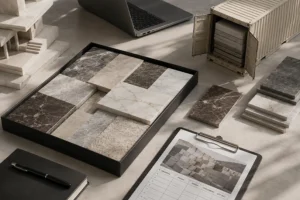
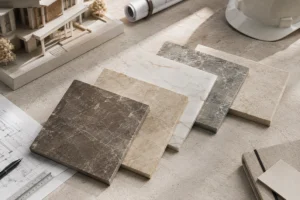
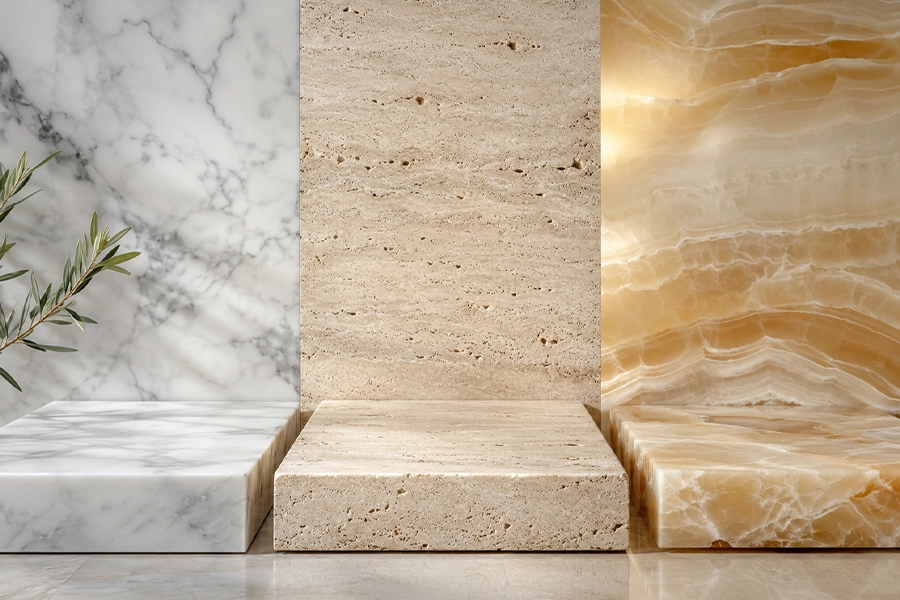
Natural stone can transform an architectural project, combining natural character with long-lasting visual appeal. Among the most widely selected materials for premium architecture are marble, travertine, and onyx.
But which one is right for your project?
The answer depends on more than appearance. Professional buyers need to consider the intended application, technical specifications, finish, dimensions, thickness, quantity, maintenance requirements, visual consistency, and overall procurement budget.
In this guide, we compare marble vs travertine vs onyx to help construction companies, architects, developers, contractors, distributors, and procurement teams make a more informed material decision.
Marble, Travertine, and Onyx at a Glance
| Feature | Marble | Travertine | Onyx |
|---|---|---|---|
| Appearance | Elegant veining and broad color variation | Natural texture and earthy tones | Dramatic patterns and translucent character |
| Common Applications | Luxury interiors, floors, walls, stairs | Façades, floors, walls, landscaping | Feature walls, luxury interiors, decorative elements |
| Design Style | Classic, contemporary, luxury | Natural, modern, traditional | Luxury, statement, high-end |
| Finishes | Polished, honed and others | Honed, brushed, textured and others | Polished, honed and decorative finishes |
| Best For | Premium architectural surfaces | Versatile architectural applications | High-impact interior design |
There is no universal winner. Each material has its own strengths and is suited to different project objectives.
1. Marble: A Classic Choice for Premium Architecture
Marble is one of the most recognized natural stones in architecture and interior design.
Its natural veining, colors, and patterns make it particularly attractive for projects where visual quality and architectural character are important.
Common Marble Applications
Marble can be used for:
- Luxury residential interiors
- Hotel and hospitality projects
- Flooring
- Interior wall cladding
- Staircases
- Reception areas
- Feature walls
- Countertops and architectural surfaces
- Decorative elements
Why Choose Marble?
Marble can be a strong choice when the project requires a sophisticated and distinctive appearance.
Its broad selection of colors and natural patterns allows designers and architects to create anything from subtle contemporary surfaces to highly dramatic interiors.
For large projects, however, buyers should carefully evaluate color range, veining, dimensions, thickness, finish, and batch consistency.
2. Travertine: Versatile and Naturally Textured
Travertine has a distinctive natural texture that works well across a wide range of architectural styles.
Its earthy tones and characteristic surface make it a popular option for both interior and exterior applications.
Common Travertine Applications
Travertine can be considered for:
- Building façades
- Exterior cladding
- Interior walls
- Flooring
- Staircases
- Landscaping
- Commercial buildings
- Residential developments
- Hospitality projects
Why Choose Travertine?
Travertine is often selected when a project requires a natural architectural appearance with a warm and versatile aesthetic.
Depending on the project requirements, different surface finishes and specifications can create significantly different visual results.
For professional procurement, buyers should clearly define the required thickness, dimensions, finish, color range, and quality level.
3. Onyx: Designed to Make a Statement
Onyx occupies a different position from marble and travertine because it is frequently selected for its exceptional visual impact.
Its natural patterns, colors, and translucent characteristics can make it an effective material for statement architectural elements.
Common Onyx Applications
Onyx is commonly considered for:
- Feature walls
- Luxury hotel interiors
- Reception areas
- High-end residential projects
- Decorative surfaces
- Bars and hospitality spaces
- Premium bathrooms
- Statement architectural elements
Why Choose Onyx?
If the primary objective is to create a visually distinctive focal point, onyx can be an excellent material to consider.
For projects using onyx, material selection should be especially careful. Pattern, color, slab characteristics, thickness, and visual continuity can have a major impact on the final design.
Marble vs. Travertine: Which One Should You Choose?
The choice between marble and travertine often comes down to the project’s design direction and application.
Choose Marble When:
- A premium and elegant appearance is required
- Natural veining is an important design element
- The project focuses heavily on interior aesthetics
- The material will be used for luxury architectural surfaces
- A wide range of colors and patterns is desired
Choose Travertine When:
- A natural and earthy appearance is preferred
- The project includes exterior architectural applications
- A textured natural surface is desirable
- The material needs to work across multiple applications
- The design calls for a warmer, more organic aesthetic
Both materials can be suitable for high-end projects when the correct specification and finish are selected.
Travertine vs. Onyx: Which Is Better?
Travertine and onyx serve very different design purposes.
Travertine is often selected as a versatile architectural material, while onyx is frequently used as a statement material.
Travertine May Be Better For:
- Large surface areas
- Façades
- Flooring
- Exterior applications
- Landscaping
- Large commercial projects
Onyx May Be Better For:
- Feature walls
- Reception areas
- Luxury interiors
- Decorative applications
- High-end hospitality spaces
- Statement architectural features
For large surface areas, procurement efficiency and consistent supply may also become important factors when selecting the material.
What About Durability?
Durability should always be evaluated according to the specific stone, application, installation method, finish, and project environment.
Instead of assuming that one stone is universally more durable than another, project teams should evaluate the technical requirements of the intended application.
Important considerations may include:
- Expected traffic
- Interior or exterior use
- Exposure to environmental conditions
- Surface finish
- Installation method
- Maintenance requirements
- Thickness
- Project specifications
For demanding applications, technical evaluation should be completed before final material selection.
Thickness and Dimensions Matter
Regardless of whether you choose marble, travertine, or onyx, dimensions and thickness are critical procurement specifications.
Before ordering, confirm:
- Length
- Width
- Thickness
- Slab or tile format
- Cutting requirements
- Dimensional tolerances
- Calibration requirements
For large construction projects, consistent dimensions can improve installation efficiency and help reduce unnecessary material waste.
A professional supplier should be able to discuss these requirements before production or order confirmation.
Surface Finish Can Change the Look of the Stone
The same natural stone can look dramatically different depending on its finish.
Common options may include:
- Polished
- Honed
- Brushed
- Tumbled
- Flamed
- Sandblasted
- Textured or natural
The correct finish depends on the application, design intent, maintenance requirements, and technical specifications.
For example, a polished finish can emphasize the color and natural pattern of certain stones, while honed or textured finishes can create a more understated architectural appearance.
How Should B2B Buyers Compare Natural Stone?
For professional procurement teams, the comparison should go beyond the material name.
A useful evaluation framework is:
1. Application
Where will the material be installed?
2. Technical Requirements
What thickness, dimensions, finish, and specifications are required?
3. Visual Requirements
What colors, patterns, and levels of natural variation are acceptable?
4. Quantity
Can the required quantity be supplied consistently?
5. Budget
What is the target cost and overall procurement budget?
6. Availability
Can the same or similar material be supplied for future project phases?
7. Packaging
What packaging is required for transportation and handling?
8. Supplier Capability
Can the supplier meet the technical and commercial requirements consistently?
This approach allows buyers to select a material based on the complete project rather than price or appearance alone.
Which Natural Stone Is Best for Large Projects?
There is no single answer.
The best natural stone depends on the project’s application and priorities.
For premium interior surfaces: Marble may be an excellent choice.
For versatile architectural applications: Travertine may offer a practical solution.
For high-impact luxury interiors: Onyx can provide a distinctive visual statement.
For large-scale projects, however, material selection should also consider quantity, consistency, technical specifications, availability, packaging, and commercial terms.
Natural Stone Comparison for B2B Procurement
| Project Requirement | Recommended Consideration |
| Luxury interior | Marble or Onyx |
| Feature wall | Onyx or selected Marble |
| Hotel interiors | Marble, Travertine, or Onyx |
| Exterior façade | Travertine or suitable architectural stone |
| Large flooring areas | Marble or Travertine, depending on specifications |
| Staircases | Marble, Travertine, or other suitable stone |
| Decorative elements | Marble or Onyx |
| Landscaping | Travertine and suitable outdoor stone |
These are general considerations. Final material selection should always be based on the project’s technical requirements and intended application.
How to Make the Final Decision
Before choosing between marble, travertine, and onyx, ask these questions:
- Where will the stone be installed?
- What visual effect should it create?
- What dimensions and thickness are required?
- Which surface finish is appropriate?
- What level of color and pattern variation is acceptable?
- How much material is required?
- Can the required quantity be supplied consistently?
- What is the project budget?
- What packaging is required?
- Will additional quantities be needed later?
Once these factors are defined, comparing materials becomes much easier.
Conclusion
When comparing marble vs travertine vs onyx, there is no universally superior material. Each offers different visual and architectural characteristics.
Marble is well suited to premium architectural surfaces and elegant interiors. Travertine offers versatility and a distinctive natural texture across interior and exterior applications. Onyx is particularly valuable when the goal is to create a dramatic and memorable design feature.
For professional B2B buyers, the right choice should ultimately be based on application, technical specifications, quality, quantity, availability, finish, budget, and supply requirements.
At Foolad Sazeh Artin Pishro, we help contractors, developers, distributors, architects, and procurement teams source natural stone according to specific project requirements, including material selection, dimensions, thickness, finish, quality, quantity, and customized packaging.
Not sure which natural stone is right for your project?
Request a Quote and share your project specifications with our team.